


In Praise of Bluebells
The bluebell is officially the UK’s favourite wild flower – for me, it is the true herald of spring. Writing in early March, I note that the green leaves of our Spanish bluebells are now showing well amongst the snowdrops in our Little Paxton garden.
I first got to know this wonderful flower when I visited local woodlands north of Leeds during my childhood. We had the classic “Observer’s Book of Wildflowers”, priced at 5 shillings, which is still used today!
Also called wild hyacinths, bluebells do not occur in the Scottish Highlands, the Northern Isles or Ireland. It is a uniquely British flower and over 50% of the world population is located within our shores. Outside the UK, a small scattered population can be found on the Atlantic coast of Spain, France and Portugal. The bluebell has been greatly praised in literature – the 19th century East Anglian poet John Clare wrote “for the woodlands are full of bluebells and the hedgerows full of blossom.”
On a more practical basis, the sticky sap from the flower was used as a glue in 16th century book-binding and also in the preparation of feathers for arrow flights.
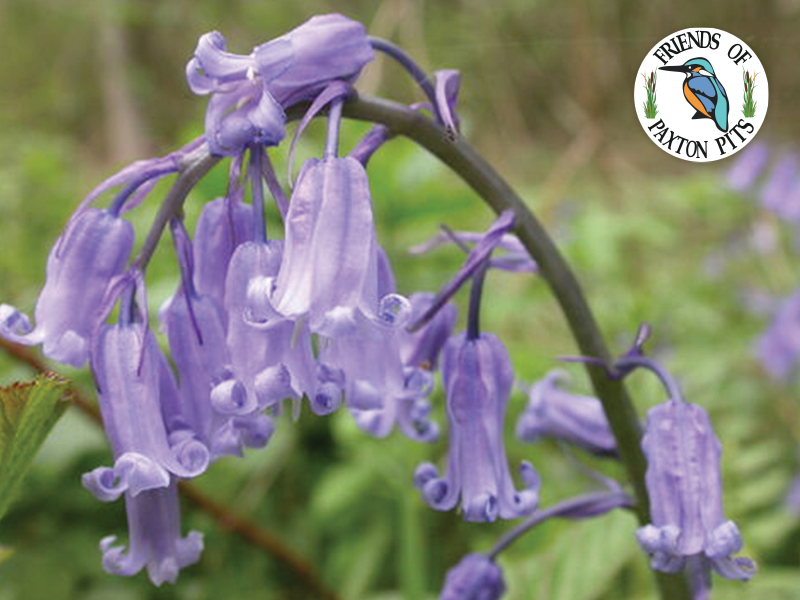
You can enjoy wild bluebells in many local woodlands – try a visit to the Wildlife Trust reserves at Waresley and Gransden Woods. The footpaths can be very muddy after rain, but do try to keep to them. These protected ancient woodlands are very special and are carefully looked after by the Trust.
Looking at the future of bluebells, they are totally associated with traditionally managed ancient woodlands, of which only 5% remain today. I am sure that we all love our garden bluebells – these are often a different species to our native ones and are called Spanish bluebells. The problem is that they hybridise freely with our native plants and therefore pose a real threat to them. If you dig up your garden bluebells, please do not dispose of them in a nearby green space, park or nature reserve!
April is a wonderful month and wildlife celebrates the milder conditions. Chiffchaffs and blackcaps will be singing, and in our gardens blackbirds and robins will also be in good song. The early dawn chorus can be a great joy – why not give it a try!
Come and enjoy your local nature reserve, with a host of new arrivals. See your first swallow and hear your first cuckoo of the year – you can be assured of a warm welcome!
With good wishes for some great wildlife watching,
Trevor Gunton (30 years a Paxton Volunteer)
www.paxton-pits.org.uk
01480 406795
