


Correction to March edition
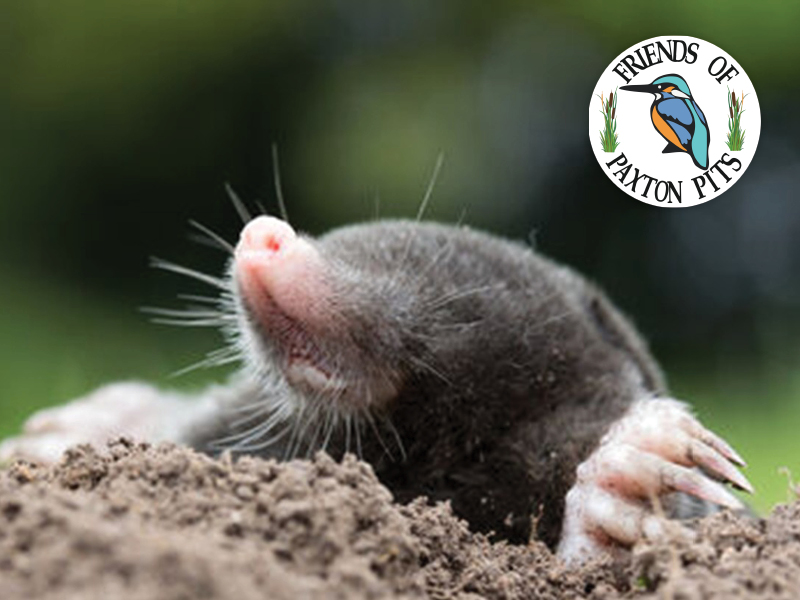
Finding out More about Moles
It’s springtime at last! Blackthorn, daffodils, singing birds and moles!
During late January and February, we had a very large number of mole hills in the meadow behind the Visitor Centre at Paxton Pits. So, in response to questions, I have attempted to find out more about this interesting mammal. In many ways, it is a simple social and cultural history of the mole’s relationship with humans.
Have you ever seen a live mole? They measure between 115mm and 150mm and weigh 65 – 120 grams. Many attempts have been made to estimate the number of moles based on the actual number of mole hills in a given area, and recent work suggests that there may be 4 moles per acre in the winter and up to 8 in the summer.
The UK Mammal Society suggests that we have around 41.04 million moles in the UK and that they are found from Spain to eastern Russia. Moles live in underground tunnels and in the winter, they live in nests lined with dried grass, roots and leaves. These structures are known as castles. They remain active throughout the year and they can climb and swim. Despite some information, moles are not blind. They eat mainly earthworms, with some slugs and snails. Studies tell us that moles live for around three years and that two-thirds of the population die each year.
Humans remain the mole’s only predator – this has been so for many hundreds of years. Most large estates in the past employed a full-time mole catcher, and as recently as 2006, Queen Elizabeth II appointed an official mole catcher at Sandringham in Norfolk. Most local counties had mole catchers working and it is documented that they enjoyed a good living. In the 1920s, one local Kimbolton man could charge up to 2 shillings and sixpence for a full skin. Interestingly, a Wisbech company continued trading well into the 1980s. It is recorded that it took around 100 fine moleskins to make a waistcoat!
So, despite people’s continued “war” against the mole, its population remains stable and some say it is actually increasing! One name for the mole used historically was mouldiwarp – do you know any local names still in use today?
Hopefully, this article may help you to better understand this unique and fascinating British mammal. Enjoy a wonderful wildlife watching spring!
Trevor Gunton (30 years a Paxton Volunteer)
www.paxton-pits.org.uk
01480 406795
Friends of Paxton Pits Nature Reserve is a charity registered in England & Wales, No. 1125221, and is funded entirely by members and fundraising activities.
